

Learn how an amended tax return works so you can fix tax mistakes, claim missed credits, and move forward with confidence.
Filing taxes can feel like a big project, so it can be stressful when you realize something is wrong on a return you already filed. The good news is that you usually have a way to correct those mistakes with an amended tax return.
When you understand how an amended tax return works, you can correct errors, claim missed money, and respond to IRS letters with less worry. In this guide, you will walk through when you should amend, when you do not need to amend, how to file an amended tax return step by step, and what to expect after you send it in.
What is an Amended Tax Return?
An amended tax return is a corrected tax return that you file after you already filed your original return. It tells the IRS that something changed or that you found an error and need to update your information.
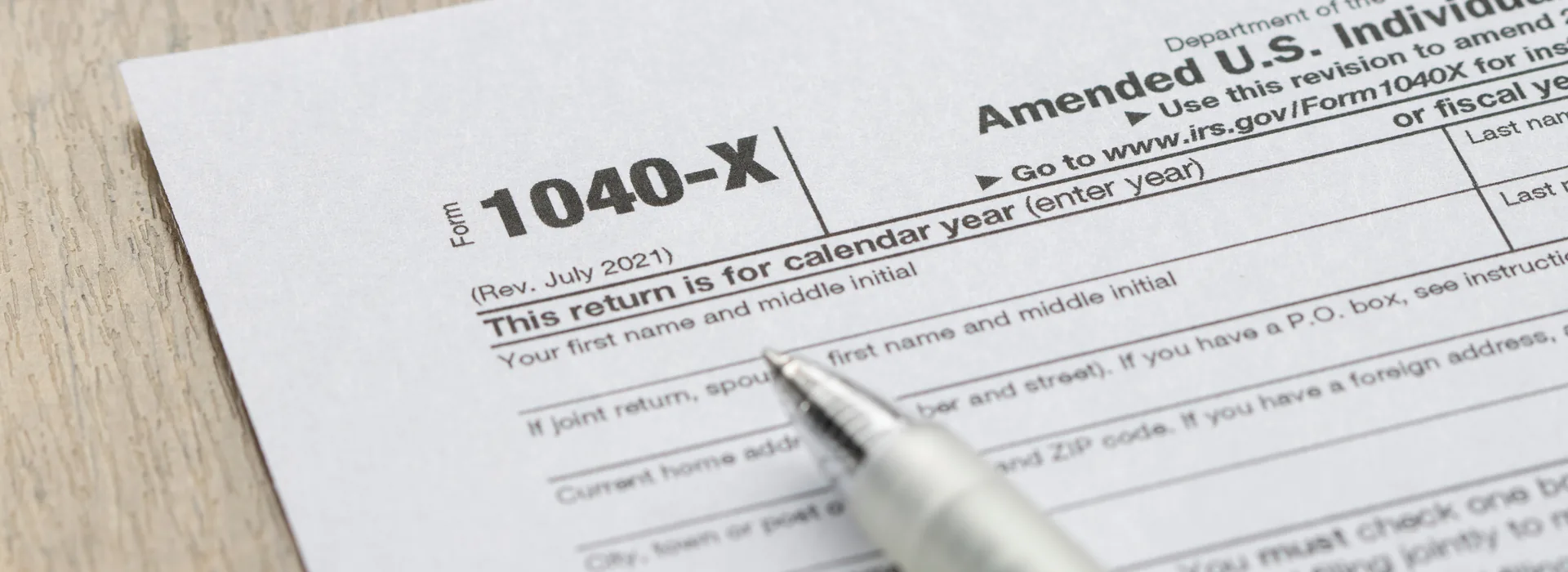
You usually use Form 1040-X, Amended U.S. Individual Income Tax Return, when you need to fix a federal income tax return. This form lets you correct your income, filing status, dependents, deductions, and credits, or any other part of your original Form 1040, 1040-SR, or 1040-NR.
An amended tax return is not the same as fixing simple math errors. The IRS can correct basic math or missing form errors for you. You use an amended tax return when the changes affect your tax calculation, your refund amount, or the tax you owe.
When You Should File an Amended Tax Return
You might decide to file an amended tax return in several common situations. Knowing these can help you decide your next step without a lot of stress.
Correcting Your Filing Status
If you picked the wrong filing status, an amended return can fix it. For example, you might need to amend if:
- You filed as Single but you qualified as Head of Household.
- You filed separately from your spouse but decided that Married Filing Jointly would be more accurate for that year.
- Your filing status affects your tax rate, standard deduction, and which credits you can use. A change here can lead to a refund or a higher tax bill, so it is important to get it right.
Adding or Correcting Income
Sometimes you file your return and later receive another tax form in the mail. Common examples include:
- Form W-2 from a job you forgot about
- Form 1099-NEC or 1099-MISC for freelance work
- Form 1099-INT or 1099-DIV for interest or dividends
- Form 1099-B for investment sales
If you left off income, the IRS might send you a notice later because it also receives copies of these forms. Filing an amended tax return on your own, before or after a notice, can help you correct the record and often reduce penalties or extra interest compared to waiting.
Fixing Claiming Dependents
Dependents can affect your Child Tax Credit, Earned Income Tax Credit, and other benefits. You may need an amended tax return if:
- You forgot to claim a qualifying child or dependent
- You claimed someone who does not qualify
- You and someone else both claimed the same person and you need to adjust
Because dependent rules are detailed, many people discover errors after the fact. An amended tax return allows you to correct who you claimed, which can change your refund or the tax you owe.
Updating Deductions and Credits
Sometimes you find out after filing that you missed a credit or deduction you qualified for. You might file an amended tax return if you:
- Forgot to claim education credits
- Left out student loan interest
- Missed the Earned Income Tax Credit (EITC)
- Did not include retirement contributions that qualify for the Saver’s Credit
- Did not claim eligible itemized deductions, such as state taxes paid, mortgage interest, or charitable contributions, if you itemize
Claiming these benefits can increase your refund or reduce your tax bill. An amended tax return is often how you access that money if you already filed.
Responding to an IRS Letter
If the IRS sends you a notice or letter that shows a mismatch between what you filed and what they have, you might fix the issue with an amended tax return.
For example, if the IRS shows higher income for you than what is on your return, you can use Form 1040-X to correct your return and include the missing forms. In other cases, the IRS letter might say that they already adjusted your return, which may mean you do not need to amend. You can read the letter carefully or talk to a tax professional if you are not sure.
When You Do Not Need an Amended Tax Return
Sometimes you do not need to file an amended return at all. Knowing this can save you time and worry.
Simple Math or Typo Errors
If you made a small math mistake or a basic typo, the IRS often corrects it during processing. For example, if you added numbers wrong or copied an amount incorrectly, the IRS usually fixes that and sends you a notice that explains the change.
In these cases, filing an amended tax return is not needed, unless you see something in the notice that is still not right.
Missing Forms That Do Not Change Your Tax
Sometimes the IRS sends you a letter asking for a copy of a document that supports something you already reported, like a W-2 or 1099 that matches your return. If the numbers on your return are already correct and you only forgot to attach a form, you might just mail or upload the requested document instead of filing an amended return.
Very Small Differences
If a change would be very small or would not change your tax or refund, the IRS generally does not require an amended return. For example, if rounding differences are only a dollar or two, that usually does not need an amendment.
However, even small differences can matter if they affect credits, deductions, or future years. If you are unsure, consider talking with a tax professional who can help you decide.
How Long Do You Have to File an Amended Tax Return?
There are time limits for when you can claim a refund using an amended tax return. These limits are called the statute of limitations.
In many cases, you must file Form 1040-X within:
- 3 years from the date you filed your original return, or
- 2 years from the date you paid the tax,
- whichever is later.
If you filed early, the IRS usually treats your return as filed on the due date. For example, if your return was due April 15, and you filed on March 1, the 3-year clock normally still starts on April 15.
If you amend a return after those time limits, the IRS can still process corrections, and you still need to pay additional tax if you owe, but you usually cannot get a refund for older years.
How to File an Amended Tax Return Step By Step
Filing an amended tax return might sound complex, but you can break it into clear steps.
Step 1: Gather Your Original Tax Return
Start by finding a copy of the original tax return you filed for that year. You will need:
- Your original Form 1040, 1040-SR, or 1040-NR
- All original schedules, like Schedule A, B, C, or E
- Any original W-2 and 1099 forms
You will also need any new or corrected forms that caused the change, such as a new 1099, a corrected W-2, or documentation for a credit you missed.
Step 2: Confirm That Amending is Needed
Before you begin, check whether an amended tax return is actually required. Ask yourself:
- Does this change my income, deduction, credit, or filing status?
- Will this change my refund amount or the tax I owe?
- Did the IRS already correct this issue in a notice?
If the answer is yes to the first two questions, and no to the last one, then an amended tax return is usually the right tool.
Step 3: Get Form 1040-X
Form 1040-X is the main form for an amended federal tax return. You can get it from the IRS website, along with instructions. In recent years, the IRS has allowed e-filing of many amended returns for Form 1040 and 1040-SR, which can speed up processing. Some older years may still need to be mailed.
Along with Form 1040-X, you will attach any corrected or new schedules that show the changes you are making.
Step 4: Fill Out Form 1040-X Carefully
Form 1040-X has 3 columns:
- Column A shows the amounts from your original return or from a return the IRS has already adjusted.
- Column B shows the net change, which can be an increase or decrease.
- Column C shows the corrected amount after the change.
For example, if you originally reported $30,000 of income but forgot to add $2,000 from a 1099, Column A would show $30,000, Column B would show $2,000, and Column C would show $32,000.
On the back of Form 1040-X, there is a section where you explain the changes. Use clear, simple language, such as "Added Form W-2 from second job" or "Claimed American Opportunity Credit for eligible college expenses."
Step 5: Attach Supporting Forms and Schedules
If your changes affect specific schedules, you should include updated versions of those with your Form 1040-X. For example:
- If you add self-employment income, include a revised Schedule C and possibly Schedule SE.
- If you adjust itemized deductions, include a new Schedule A.
- If you add or change credits, attach any forms used to claim those credits, such as education credit forms.
You should also attach any new W-2 or 1099 forms that relate to the change.
Step 6: File Your Amended Tax Return
You may be able to file your Form 1040-X electronically, depending on the year you are amending and the tax software you use. If e-filing is not available, you will mail Form 1040-X and attachments to the address listed in the IRS instructions for your state.
If your amended return shows that you owe more tax, you can reduce interest and possible penalties by paying as soon as you can. You can usually pay online to speed this up.
If your amended return shows a refund, the IRS will send you that refund after processing. If you are also expecting a refund from your original return, you generally want to wait until that original refund arrives before you file an amended return.
Step 7: Track Your Amended Return
Amended tax returns take longer to process than regular returns. The IRS often says it can take up to 20 weeks or more. That time frame can change based on volume and other factors.
You can track the status using the IRS "Where’s My Amended Return" online tool. It usually shows updates after the IRS has your amended return in the system. You will need your Social Security number, date of birth, and ZIP code to check.
How Amended Tax Returns Affect Your Refund or Balance Due
An amended tax return can change your tax outcome in 3 general ways.
You May Get an Additional Refund
If you add deductions or credits, or if you correct income that was originally too high, you might receive more money back. This is often what happens when you discover a missed education credit or a missed dependent.
If the IRS agrees with your corrections, they will issue an additional refund. This usually comes as a check or direct deposit, depending on your preference and what the IRS system allows for amended returns.
You May Owe More Tax
If you forgot to include income or claimed credits you did not qualify for, your corrected return might show that you owe more tax. When that happens, you will need to pay the extra amount, plus interest, and possibly penalties.
Paying as soon as you can often reduces the total cost over time. The IRS adds interest until the tax is paid in full.
Your Total Tax May Stay The Same
In some cases, your changes might cancel each other out. For example, you might discover extra income but also find a new deduction that offsets it. In those situations, it is still important to file an amended tax return so that your records match reality, even though the final tax owed does not change.
What About State Amended Tax Returns?
If you change your federal return, your state tax return may need changes too. Many states use your federal adjusted gross income as a starting point, so when that number changes, your state tax can change as well.
Each state has its own form and process for amended returns. Some use a separate "amended" form, while others have you check a box on the regular state form to show that it is an amended version. You can usually find instructions on your state tax agency website.
If you amend your federal return, it can be a good idea to check whether your state return needs to be amended at the same time. That way your records stay consistent across federal and state taxes.
Common Mistakes to Avoid with Amended Tax Returns
Amended returns are meant to fix mistakes, but there are a few new mistakes you want to avoid.
Do Not File Too Soon After Your Original Return
If you just filed your original return and then notice an error, you might want to wait until the first return has finished processing before you file an amended one. Filing too early can make it harder for the IRS to match the two returns correctly.
Do Not Forget to Include All Related Changes
When you change one part of your return, it can affect other parts. For example, adding income can change your credits and your deductions that have income limits.
You want to update all lines that are affected, not just the original error. Tax software or a tax professional can often help with this so that you do not miss a related item.
Do Not Ignore IRS Notices
If you get a letter from the IRS, do not ignore it and assume that your amended tax return will just fix everything without a reply. You might need to respond directly to the notice while you work on your amendment.
Following the directions in the letter and keeping copies of all documents you send can help avoid confusion later.
When to Consider Getting Tax Help
You can file an amended tax return on your own, but there are times when getting help may be useful. For example:
- The change involves self-employment or business income
- You are adjusting investment income and capital gains
- You are unsure about dependent rules or credits
- You received an IRS notice that you do not understand
A qualified tax professional can help you review your original return, explain your options, and prepare Form 1040-X accurately.
How Check City May Fit Into Your Tax Plans
Some people choose to work with tax preparation services to file an original or amended tax return, especially when their finances start to include more forms, dependents, or credits. In some locations, Check City offers tax services that can help you file returns and understand your tax situation more clearly.
If you prefer in-person help, it can be helpful to check whether there is a nearby location in your state that offers tax support. You can also look for other reputable tax professionals or organizations that match your needs.
Moving Forward After an Amended Tax Return
An amended tax return is simply a tool you can use to fix your tax filing, not a sign that you did something wrong forever. Many people discover new information, receive extra forms, or learn about credits after filing, and updating a return is a normal part of that process.
The key steps are to decide if a change is needed, gather your documents, complete Form 1040-X with clear explanations, and follow up on any federal or state effects. Then you can track the status and adjust your budget for any refund or extra payment that comes from the amendment.
When you understand how an amended tax return works, you can correct mistakes, claim money you missed, and stay on top of your tax record with more confidence each year.
This content is for informational purposes only and does not constitute financial or legal advice. Loan products, terms, amounts, rates, fees, and funding times may vary by state and applicant qualifications. All loans are subject to approval and verification under applicable law. Check City is a licensed lender in each state where it operates. Loans are intended for short-term financial needs only. Please borrow responsibly.


